AI search and organic discovery
How to make a B2B company discoverable in AI search
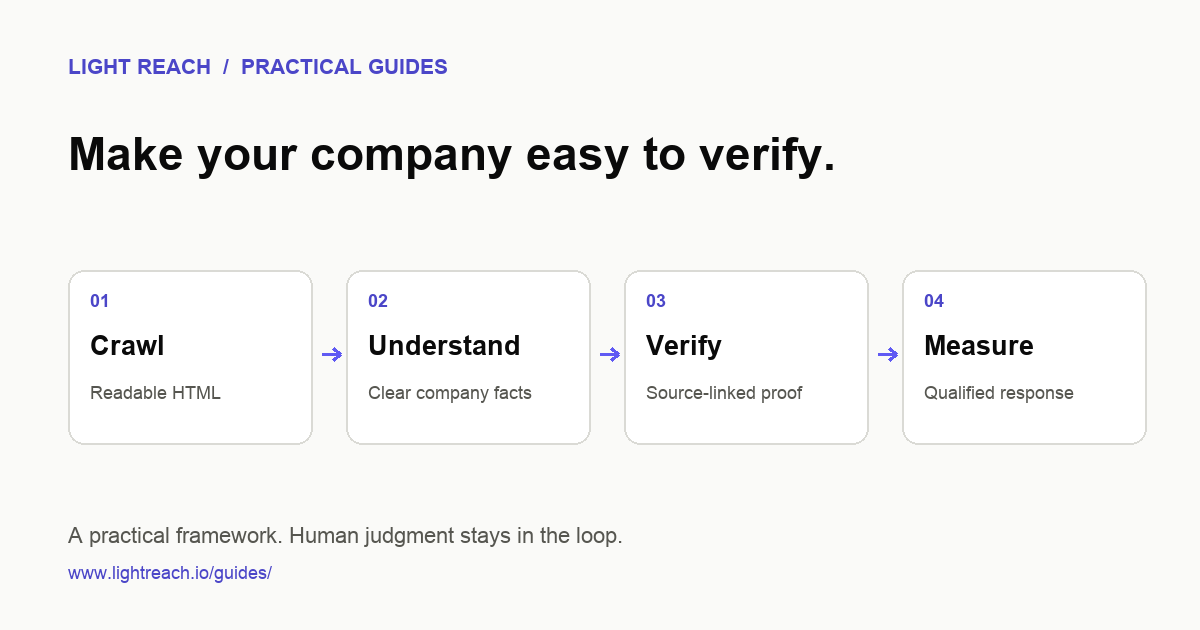
Make your company easy to find, understand, and verify: serve useful content in the initial HTML, keep canonical URLs consistent, answer specific buyer questions, publish evidence with its limits, and measure qualified visits. Google’s AI search features use the same SEO foundations as ordinary search. No file or schema guarantees an AI recommendation.
What do SEO, AEO, and GEO mean in practice?
SEO improves how search engines discover and present your pages. Answer engine optimization (AEO) focuses on whether a page clearly answers a question. Generative engine optimization (GEO) focuses on whether AI systems can accurately describe and cite your company. For a B2B team, these overlap around useful, accessible, verifiable content.
Start with questions a buyer would ask before a meeting: What does this product do? Who is it for? What can I verify? What happens after I sign up? Which constraints should I understand? A concise answer followed by evidence is more useful than a page repeating broad category keywords.
Check what a crawler receives before JavaScript runs
Open a public page’s source or fetch it with an HTTP client. It should already contain the main heading, the answer, links, and product explanation. A blank application root asks every crawler to run your JavaScript successfully before learning anything. Prerender public marketing and documentation pages; keep account screens separate.
URL identity matters just as much. If your host redirects /product to /product/, use /product/ in the canonical tag and sitemap. Unknown URLs should return a real 404 instead of a successful homepage. A robots.txt request should return plain text, and a sitemap request should return XML, not an application shell.
Our October 12, 2026 audit found this on Light Reach: Cloudflare served /signal/ and /crawl/ while their canonical tags named the slashless URLs, which redirected. Google listed the served pages as alternate canonicals. We also fetched an invented URL and received the homepage with HTTP 200. The corrective work aligns URL identity and adds a real error document; traffic impact remains unmeasured.
- Fetch the canonical page and confirm HTTP 200 without an extra redirect.
- Confirm the initial HTML contains the visible answer and exactly one canonical URL.
- Compare the canonical, sitemap URL, and final hosted URL.
- Check robots rules and CDN access for search crawlers.
- Request a nonexistent URL and confirm HTTP 404.
Publish one clear company and product record
Create a company page that states your name, category, audience, leadership, official profiles, and current products. Link to it from product pages. Use consistent names across the website and official profiles, and distinguish what is available today from the long-term vision.
Structured data can describe that visible record. Organization, WebSite, Article, and breadcrumb markup should match the page. Inventing ratings, customers, prices, or awards to fill a schema makes the record less trustworthy. An llms.txt file may summarize sources, but Google does not require an AI text file or special AI markup for its generative search features.
Give buyers something they can verify
Publish a worked example, a documented evaluation, or a customer story with a defined outcome. Include the measurement window, baseline, method, and limitations where available. Keep an illustrative product demo visibly labeled as illustrative. A synthetic development test does not establish customer success or competitor superiority.
Light Reach’s evaluation page separates historical task tests from a separate archived coding benchmark. That distinction helps a reader decide what the result actually supports. The useful pattern is not a bigger headline number; it is a claim with enough context to inspect.
Earn outside references by contributing something useful: a technical explanation, a reproducible check, or an honest account of a tradeoff. Publish through your own identity and disclose your affiliation. Community posts should help the reader even if they never visit your site.
Measure discovery and buyer response separately
Record a starting point before the release: indexed pages, search clicks and impressions, branded versus non-branded queries, and landing pages. Google Search Console supplies the search baseline. Your analytics should connect landing pages and referrers to meaningful actions, such as a qualified pilot inquiry.
For AI answers, use a fixed set of buyer questions. Record the engine, date, question, answer, cited sources, and whether the description is accurate. Repeat the same questions after changes. Answers vary, so one favorable response is an observation, not a market-wide visibility score.
Review leading signals first: crawlers receive useful HTML, canonical pages are accepted, impressions broaden to relevant questions, and new pages get discovered. Then assess qualified inquiries. Indexing requests and sitemap submissions help discovery; neither guarantees a ranking or a traffic increase.
Sources and further reading
- Google: optimizing for generative AI search features
- Google: AI features and your website
- Google: canonical URL guidance
- Inspect Light Reach’s evaluations and limitations
- Light Reach’s company and product record
Prepared by Light Reach with AI assistance, using the linked public sources and product documentation. Examples and unmeasured outcomes are labeled in the guide.