AI engineering and evaluation
How to evaluate AI coding agents before production use
Evaluate the complete handoff: does the agent select relevant work, understand ownership, stay within scope, produce a useful diff, verify the intended behavior, and expose cost and limitations? Separate coding benchmark scores from production success. Use representative held-out tasks and human review before relying on an agent for your repository.
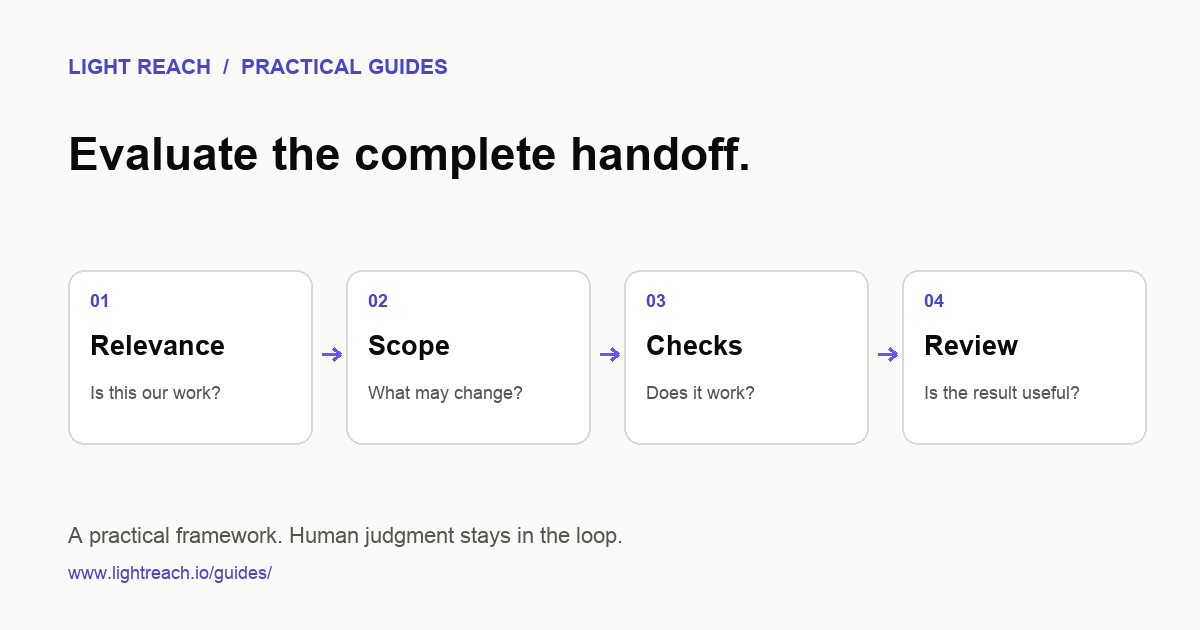
Separate the decisions an agent must get right
A code test can pass while the system works on the wrong problem. Measure task relevance first: was the request an actual commitment, did it belong to your team, and was it suitable for engineering? Then measure readiness: did the brief contain enough evidence, scope, and completion criteria to begin?
Coding quality is another decision. Did the change solve the requested behavior without weakening adjacent contracts? Delivery is another: can a reviewer inspect the diff, checks, costs, and outstanding risks? Keep these dimensions separate so a strong score in one cannot hide a failure in another.
Build a representative evaluation cohort
Select tasks from the kinds of work you intend to delegate: bug fixes, small features, uncertain requests, retries, and changes near important boundaries. Include tasks that should not proceed because ownership or evidence is missing. A good evaluation rewards an appropriate pause as well as a correct patch.
Hold out tasks from the examples used to develop the system. Record the repository revision, task text, environment, model or route, constraints, and evaluation method. Preserve failed attempts and timeouts in the denominator. Repeating a task after seeing its solution is a repair experiment, not a new independent success.
Have an engineer review usefulness and risk. Automated checks can establish a behavior, but they do not fully measure whether the plan was usable, how much correction it required, or whether the user’s underlying problem was addressed.
Require a reviewable execution record
Use the same acceptance rules for comparable runs. A record should let another engineer understand both the result and the conditions under which it was obtained.
- Task identity and repository revision: identify exactly what was attempted.
- Scope and authority: show permitted paths, operations, and approval boundaries.
- Diff: provide the changed files and explain the resulting behavior.
- Verification: report the checks run, their outcomes, and any missing environment dependency.
- Failure handling: retain errors, retries, and incomplete results rather than dropping them.
- Cost and time: measure the complete attempt, including correction and review where available.
- Human review: record whether the result was accepted, revised, or rejected.
Interpret benchmark scores with their provenance
Light Reach’s published September 2026 report includes 14/14 passing task-relevance cases and 24/24 correct engineering-readiness decisions. Those are small, agent-authored synthetic development tests using GPT-5.4. They do not establish real-world accuracy, independent plan quality, or results for another model.
A separate archived Compress Cloud run passed 64 of 113 full-cohort Datacurve DeepSWE tasks, reported as 56.6%. It is a coding benchmark result with its own conditions. It is not an end-to-end conversation-to-PR success rate, a customer outcome, an official leaderboard position, or evidence of superiority over another product.
The published report exposes these limitations and aggregate provenance. Use that style of disclosure when comparing your own candidates. A comparison is meaningful only when tasks, setup, evaluation, and attempt accounting are comparable.
Use production evidence for production decisions
Begin with bounded work that has a clear owner and an inspectable acceptance rule. Preserve human review before merging and releasing. Check the deployed behavior after release instead of treating local tests as production proof.
Track accepted changes, reviewer correction time, regressions, and cost per accepted result. Set a baseline from the current human workflow where possible. If a metric has not been measured, name the gap rather than filling it with a benchmark score.
Compress is designed to keep model choice, tool activity, costs, changes, and verification together in a run record. That makes evaluation and review easier to inspect. Your quality threshold still depends on your tasks, repository, and evidence.
Sources and further reading
- Light Reach evaluation report: scores, methodology, and limitations
- Download the aggregate scores and provenance
- Compress: approved work and verification
Prepared by Light Reach with AI assistance, using the linked public sources and product documentation. Examples and unmeasured outcomes are labeled in the guide.