GTM intelligence and decisions
What is GTM intelligence? A workflow from evidence to decisions
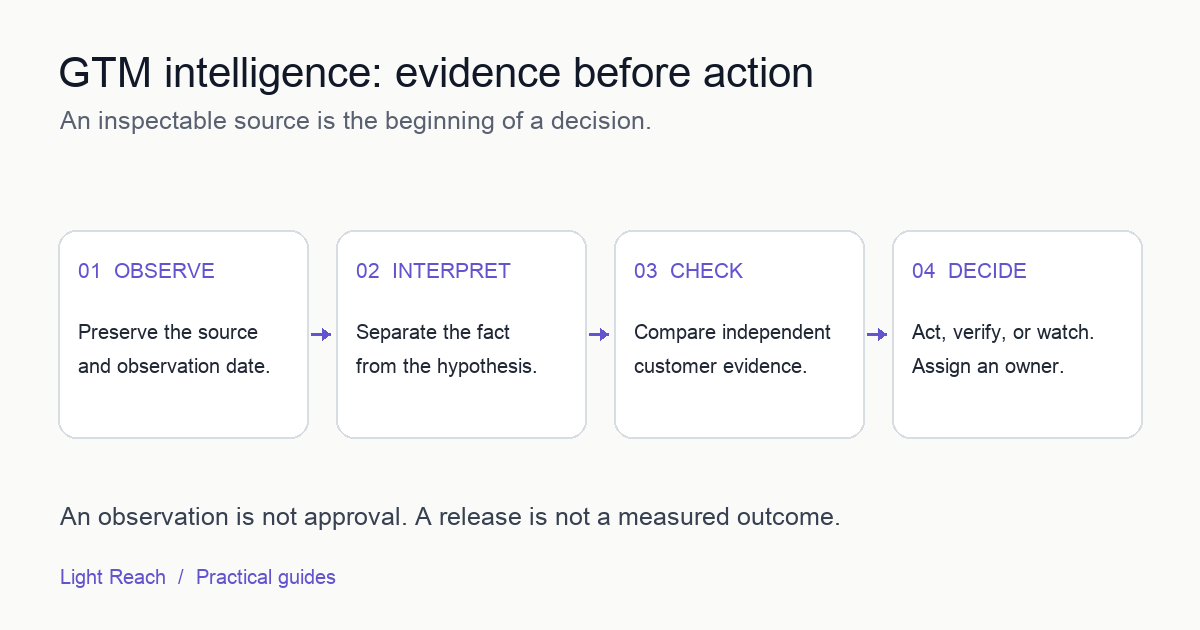
Go-to-market intelligence is evidence that helps a team decide how to reach, serve, and retain the right buyers. Our working definition includes competitor changes, customer conversations, market discussion, and response to your own positioning. A useful finding preserves its source, separates observation from interpretation, and names the decision it could change.
What does GTM intelligence include?
GTM stands for go-to-market. In a small B2B team, intelligence is useful when it changes a concrete choice: which buyer problem to investigate, how to describe a product, what to test in outreach, or which onboarding friction deserves engineering work. A feed of news without a decision attached is still just a feed.
We use four inputs: competitor positioning and product changes; customer conversations and objections; relevant market conversations; and first-party response to content, outreach, and product experience. The same event can matter differently to sales, marketing, product, and engineering. Preserve the observation once, then explain its relevance to each decision.
Start with a question, rather than monitoring every possible source. For example: “Are buyers hesitating because migration feels risky?” That question tells you which conversations, competitor claims, product failures, and response measures are relevant. More collected material does not automatically improve the decision.
How is it different from a CRM, a lead list, or intent data?
A CRM records accounts, interactions, and deal state. A lead list identifies possible contacts or accounts. Intent data estimates interest using the signals and methodology of its provider. Competitive intelligence focuses on competitors. Those inputs can inform a GTM decision, but none independently tells your team which action is justified.
A GTM evidence record connects an input to a reviewable hypothesis. “An account visited a page” is an observation. “The account is ready to buy” is an interpretation that needs further evidence. “Change our pricing” is a proposed action with a much larger burden of proof.
Keep the original source category visible. A public pricing page is evidence of a published offer. A support conversation is evidence of one customer’s experience. An outreach reply is evidence of that reply in that campaign. Avoid turning any of them into an unsupported statement about the whole market.
1. Preserve a source record before summarizing
Capture the source URL or authorized internal reference, observation date, relevant excerpt, and what changed. If you describe a change, preserve the prior observation too. A current page alone cannot prove that the wording was different last week.
Write a short factual observation that a second person can check. “The page now advertises an assisted migration service” is more inspectable than “The competitor has solved onboarding.” Keep inaccessible evidence and open questions explicit. Private customer material should remain in its authorized workspace; a public example should use an illustrative or suitably redacted record.
The download above separates the source, observation, interpretation, next check, and decision owner. You can use it in a document or your existing work tracker. The method does not depend on buying a particular tool.
- Source: preserve the reference and the relevant excerpt or response.
- Time: record when the event happened and when you observed it; do not treat them as the same date.
- Change: compare against a dated prior record when claiming a change.
- Limits: identify who the source represents and what remains unknown.
- Decision: name the question this evidence could help resolve.
2. Test the interpretation against another kind of evidence
A source and an interpretation are different artifacts. A competitor’s claim might indicate a positioning shift, a real product capability, or a marketing experiment. Record plausible alternatives before deciding which one to act on.
Compare external observations with customer and product evidence. If customers mention migration anxiety and product data shows abandoned imports, an onboarding claim becomes relevant to a specific investigation. If customers do not share that concern, copying the competitor may distract the team from a more important problem.
Independent sources strengthen a finding more than repeated copies of the same announcement. Three articles quoting one press release are still one underlying observation. Similarly, a few highly vocal replies do not establish prevalence across your customer base. Preserve both confirming and contradictory evidence.
Worked example: a migration concern becomes bounded work
This example is illustrative; it is not a measured customer case. A competitor page advertises easier migration. A customer conversation says, “If the import fails, I do not know whether retry will keep my existing workspace.” A reproduction shows the recovery state is unclear. These sources have different roles: market context, customer experience, and observed product behavior.
The interpretation is that recovery uncertainty may be contributing to migration hesitation. It is a hypothesis, not a measured loss of revenue. The next check is to reproduce interruption and retry in the existing workspace and review additional relevant feedback. The competitor claim alone does not authorize an engineering task.
If the defect is confirmed and the team owns it, a bounded decision is to improve import recovery while preserving workspace identity and committed rows. The engineering brief defines repeated-retry and invalid-checkpoint checks. A separate positioning experiment could explain the recovery behavior accurately once it is shipped.
Keep release evidence and business outcome separate. Passing the retry checks proves tested behavior. A live deployment confirms the released path. Only later observation can show whether customers encounter less friction or respond differently to the positioning. Do not fill that final gap with a plausible story.
3. Choose act, verify, or watch
Use a short decision review. Act when the source is inspectable, the problem is relevant, ownership and authority are clear, and the scope has an observable completion rule. Verify when a missing fact could materially change the choice. Watch when the event is relevant but no justified action follows yet.
Assign the next check to an owner and give the record a review date. Otherwise “verify” becomes an indefinite parking lot and old observations keep driving new decisions. Note what evidence would make you change your mind.
For a lightweight weekly review, bring the few findings attached to current decisions. Discuss the source, uncertainty, proposed action, and measurement. A short review with one justified action is more useful than an impressive activity count with no owner.
4. Measure the decision, not the volume of collected signals
Choose the outcome before acting. For an outreach test, record the audience, message, delivery window, and relevant response denominator. For onboarding work, define the user behavior and recovery failure you can actually observe. For a product decision, preserve the accepted scope and verification record.
Compare like with like. A reply-rate change can reflect audience, channel, timing, or message changes. A before-and-after observation is useful but does not automatically establish causation. Record simultaneous changes and missing instrumentation, and avoid reporting raw replies as qualified opportunities.
At Light Reach, Crawl supplies source-linked external context, while Signal compares it with customer and product evidence to rank opportunities. Approval and delivery remain separate steps. The value of the workflow is the inspectable path from source to judgment to result; the staged figures on product pages illustrate that path and are not customer performance claims.
Sources and further reading
- Crawl: external GTM evidence and labeled product examples
- Signal: evidence-based prioritization and approval
- Customer evidence to an engineering brief: worked recovery example
- Light Reach: company, audience, and product record
- Salesforce: CRM systems and customer interaction records
- 6sense: intent data definitions and source categories
Prepared by Light Reach with AI assistance, using the linked public sources and product documentation. Examples and unmeasured outcomes are labeled in the guide.