AI product engineering and decisions
What should an AI product engineer actually do?
At Light Reach, an AI product engineer helps a team investigate useful changes, compare value and tradeoffs, test product behavior, and carry approved engineering work forward. The evaluation should start with inspectable artifacts: source excerpts, research transcripts, value assumptions, reproduction steps, and release checks. The team keeps implementation and release authority.
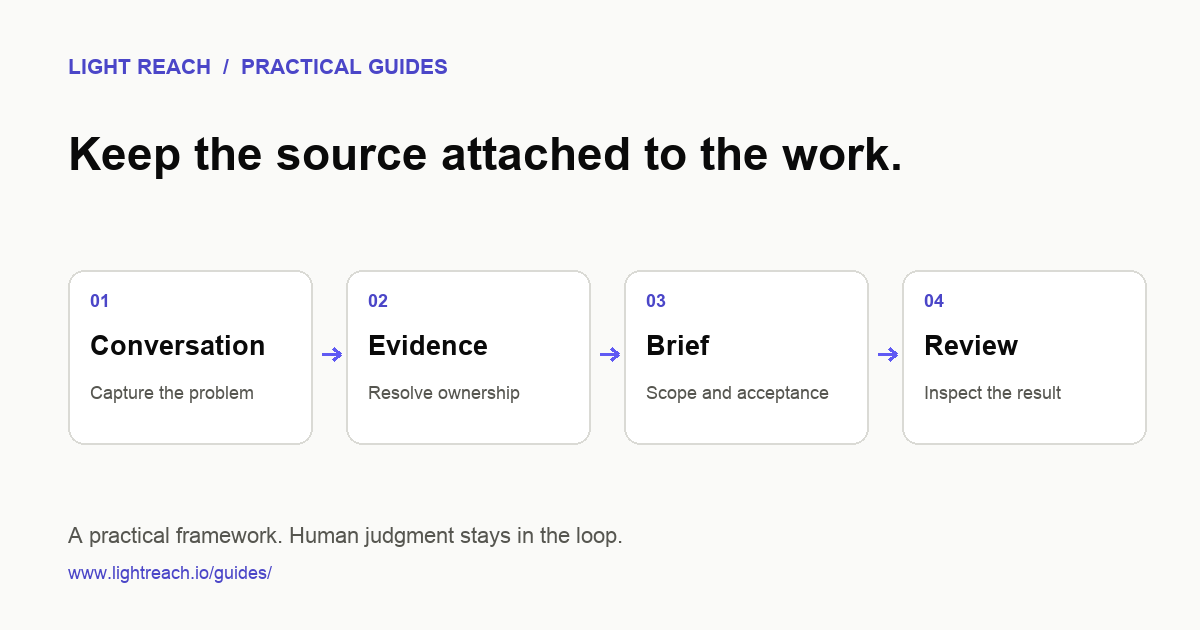
Start with the decisions your team needs to make
A useful engineering teammate helps answer three questions: which problem deserves attention, which intervention is worth trying, and whether the delivered change behaves as intended. Writing code is one part of that responsibility. A source-linked investigation can also conclude that the evidence is weak, the team does not own the problem, or a simpler operational change is preferable.
For a post-launch B2B product, inputs can include authorized customer conversations, product behavior, repository context, company objectives, and relevant market developments. Keep their roles distinct. A public competitor announcement describes that announcement; it does not establish demand from your customers. A simulated buyer conversation helps someone practice; it is not customer evidence.
Choose a specific objective before collecting more information. An example is reducing uncertainty when an import is interrupted. That makes customer reports, observed recovery behavior, and the relevant repository more useful than a general request to find ways to grow.
Inspect how the investigation challenges an idea
Ask for the original source, the relevant excerpt, the interpretation, and an alternative explanation. When agents discuss an idea, different perspectives can expose tradeoffs: the business perspective considers the affected customer and buying consequence; the engineering perspective examines feasibility, cost, and evidence that could disprove the proposal.
Their agreement is generated reasoning, not independent corroboration. The useful result is an inspectable research record containing citations, contradictions, unanswered questions, and suggested next checks. Preserve the underlying sources instead of treating a fluent summary as proof.
Actionairy has completed a bounded five-turn research mission through its production worker, and the saved transcript, citations, and cost receipts were inspected in the web client. That recovery mission used existing context and did not establish a newly discovered market opportunity. It demonstrates the research path within that scope.
Compare value, effort, and uncertainty without invented precision
A proposal needs a mechanism: who benefits, what changes for them, and how that could affect the business. Record expected benefit separately from implementation and operating costs. Use a declared currency and time horizon when comparing monetary amounts. Where the evidence cannot support an amount, keep it unknown and identify the investigation that could resolve it.
The highest-revenue hypothesis is not automatically the next priority. Dependencies, customer commitments, risk, delivery effort, and available resources also matter. Compare the proposal with leaving the product as it is and with a smaller alternative. An assessment should let a reviewer change its assumptions without losing the original forecast.
Actionairy stores revisioned value assessments and presents their current revisions across Review, briefs, and Work. This makes reasoning and corrections inspectable. It does not turn an estimate into measured revenue or prove that its ranking policy consistently chooses the best intervention.
Evaluate browser testing through a reproduced failure
Define a public journey and an observable checkpoint, such as opening a public product page and reaching its trust information. Test desktop and mobile layouts. A failure report should retain the actual steps, the observed state, and enough evidence for a second person to reproduce it. A delayed page or unfamiliar menu is not automatically a confirmed defect.
Actionairy’s released Product checks in Work cover public HTTPS browser journeys in fresh sessions. Its qualification included desktop and mobile navigation plus a deliberate 404 fixture reproduced twice. That fixture created proposed Work with private screenshots and a fix brief; it started no coding work. The fixture demonstrates the evidence and proposal path, not a newly discovered customer defect.
Authenticated journeys and native-app automation are outside the current browser-check scope. Native clients can display check results and evidence; a mobile browser layout test is a different capability from controlling an installed native app. Confirm that distinction when evaluating a tool.
A practical checklist for a product-team pilot
Bring one real problem, authorized evidence, an approval owner, and an observable completion condition. An import-recovery investigation is an illustrative example: reproduce the interruption, compare recovery approaches, preserve existing rows, and define repeated-retry and invalid-checkpoint checks. Its activation or revenue benefit stays a hypothesis until measured.
Use the downloadable engineering brief template and worked example to capture that scope in your existing document or issue tracker. If the problem is already clear and small, an ordinary issue and a human engineer may be sufficient; retain the same evidence and approval discipline.
Ask to inspect each artifact in the pilot. The evidence burden grows from a useful research transcript, to a justified proposal, to a checked implementation, to a measured outcome. Accept a narrow demonstrated capability on its own terms, and keep broader claims tied to their own proof.
- Review the source excerpts and contradictions supporting the proposed action.
- Inspect the assumptions, unknown economics, alternatives, effort, and dependencies.
- Reproduce a failure or inspect the observable acceptance checks.
- Confirm repository access, implementation approval, and release authority.
- Inspect the delivered artifact, the checks actually run, and any unresolved failure.
- Review the prospective outcome definition and the limits of its attribution.
Sources and further reading
- Actionairy: current product capabilities
- Dated first-party capability and proof record
- Engineering brief template and worked example
- Historical evaluations with model provenance and limitations
- Light Reach privacy and source controls
Prepared by Light Reach with AI assistance, using the linked public sources and product documentation. Examples and unmeasured outcomes are labeled in the guide.